Artist’s Statement
Many people take comfort in symmetry. I am more interested in controlled tension.
My work is rooted in controlled chaos. Beneath the surface disorder, there is structure, though it may not be immediately visible. Through collage, paint and found objects, I construct layered compositions to create canvases that evoke nostalgia, humor, pain, and melancholia. Social commentary often emerges, though it is never forced.
I work quickly and intuitively to access the subconscious, allowing instinct to guide form and placement. Each piece becomes a dialogue between deliberate composition and subconscious impulse. I follow the direction of the image rather than impose rigid rules upon it.
Life is too brief for safe decisions.
Biography
Michael John Bobak is a Philadelphia-based multi-disciplinary artist working primarily in mixed media and photographic collage. His practice explores themes of social commentary, memory, nostalgia, and cultural tension through layered composition and found imagery.
NEW MYTHOLOGY SERIES
Yggdrasil and the Seer of Ruin
Mixed Media 30×24″
2024
$3000
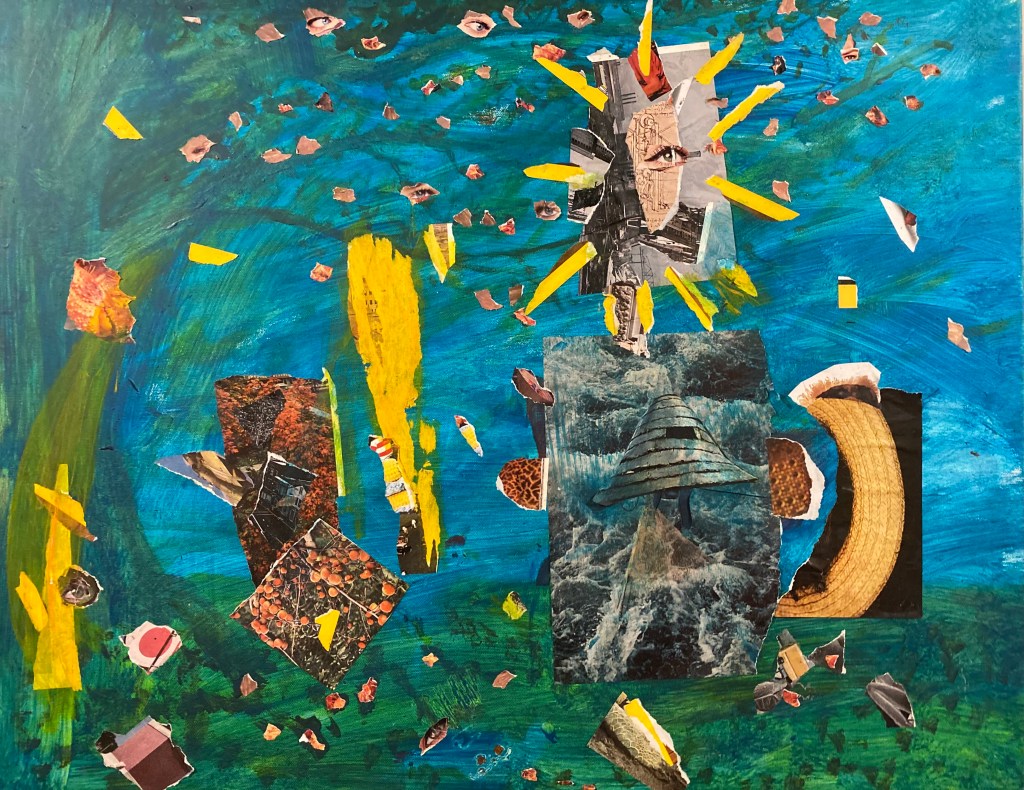
“Yggdrasil and the Seer of Ruin” is a mixed media piece that delves into the mythological depth of Yggdrasil, the Norse World Tree. Created quickly and instinctively, the piece captures a raw, subconscious energy. Eyes scattered across the top lend a watchful quality, implying that Yggdrasil itself is observing the world. Among fragmented layers of yellow, brown, and torn textures, the Völva character—a figure with a waterspout body and an iron pyramid hat—emerges subtly, blending into the tree’s natural landscape.
The composition is organic and layered, with brown torn leaves drifting through the scene, adding a sense of life and movement. A central star shape symbolizes Yggdrasil’s spiritual heart, radiating energy and connecting worlds. The combination of textures, colors, and mythological symbols brings a tactile realism as if fragments of reality are entangled in the branches of Yggdrasil.
One Small Step for a Turtle
Mixed Media 30 x 24″
2023
$3000
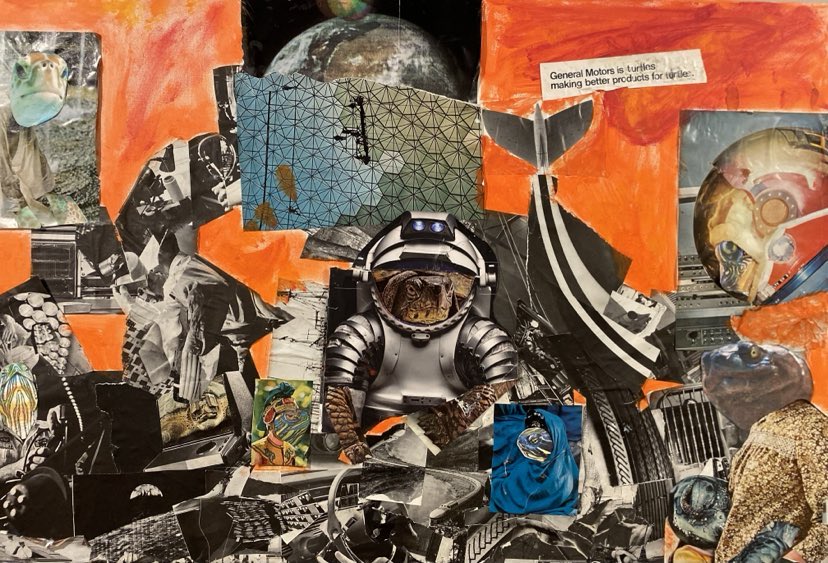
“One Small Step for a Turtle…,” I reimagine space exploration through a lens of humor and irony, asking: what if the first step into the cosmos was taken by a creature as slow and enduring as the turtle? The bold orange background creates an intense, almost apocalyptic backdrop, contrasting sharply with the black-and-white collage elements. This fragmentation hints at the chaos of history and memory, while the central turtle in an astronaut suit anchors the piece, giving viewers a point of balance amid the disorder.
The turtles, symbols of resilience and patience, juxtapose with the cold, fast-paced realm of space technology, hinting at an environmental reflection. With their shells as homes, they echo astronauts carrying life support into inhospitable territory. There’s a retro-futuristic vibe here, as if the old and the new have converged in a post-apocalyptic setting, with the debris and wreckage hinting at human ambition and its potential fallout.
Adding the slogan “General Motors is turtles making better products for turtles” underscores the piece’s playful yet critical stance. It pokes fun at corporate influence, turning a mundane slogan into a surreal commentary on industry’s absurd claims. Altogether, this piece captures a collision of nature and technology, hinting at the endurance of the natural world amidst humanity’s relentless, often reckless, progress.
Prometheus Trashed
Mixed Media 30×24″
2023
$3000
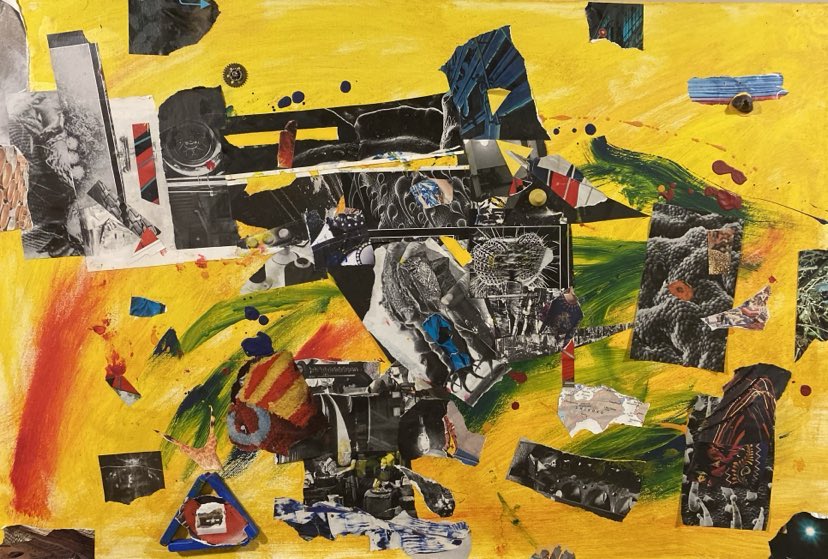
“Prometheus Trashed” is a commentary on modern life, especially on how technological and industrial advancements, once seen as saviors of humanity, can lead to destruction and waste. The piece is intended to provoke reflection on the consequences of innovation and progress, while using found objects to give it a tangible connection to the real world.
The title is meant to suggest a critique of how humanity may have squandered the gifts of knowledge and technology, leaving behind a landscape of broken pieces. The discarded, fragmented objects evoke a sense of wastefulness, suggesting that in our pursuit of technological advancement (the “fire” of Prometheus), we’ve left behind a trail of destruction.
The Seeker
Mixed media 30×24″
$3000
2023
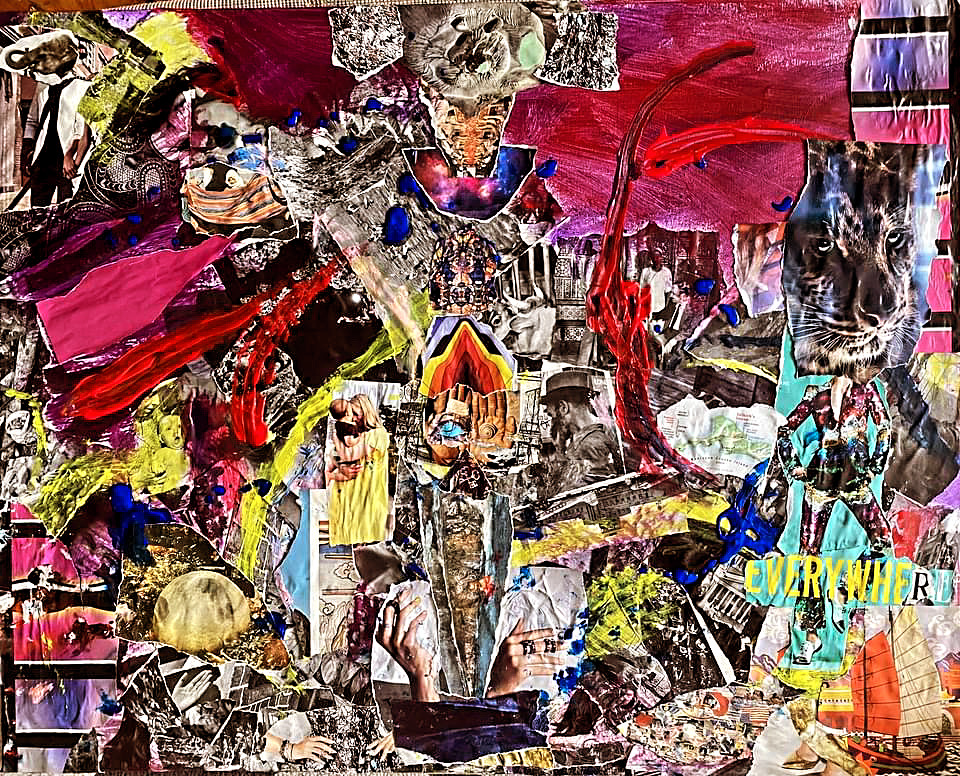
The Seeker examines faith as a human construction rather than a divine mandate. Created from an atheist perspective, the work does not argue against belief. It investigates the origin of belief itself.
The purple field establishes a sacred atmosphere without allegiance to a specific doctrine. It represents the emotional register of religion — reverence, awe, mystery — separated from institutional authority.
The vertically structured composition suggests ascent or altar, but the movement is not toward a god. It is toward source. The piece proposes that religions emerge from shared human impulses: pattern recognition, fear of death, awe at the natural world, and the need for narrative and order.
The feline presence at the top functions as archetype rather than deity. It reflects primal projection, the early human instinct to assign agency to forces beyond comprehension. The central eye represents consciousness becoming aware of its own myth-making. The seeker is not searching for God. The seeker is examining the machinery that produces gods.
Text fragments, maps, and layered imagery point to the way belief systems anchor themselves to geography and culture. Borders of land mirror borders of doctrine. Beneath those divisions lies a shared psychological origin.
The word fragment “EVERYWHERE” reinforces the saturation of faith across civilization. Religion permeates culture because it arises from the same cognitive source in every society.
The Seeker establishes the archetype of humanity interrogating its own need for transcendence. The mythology here is not divine. It is human.
Moon Maiden
Mixed Media 48×36″
2022
$5000
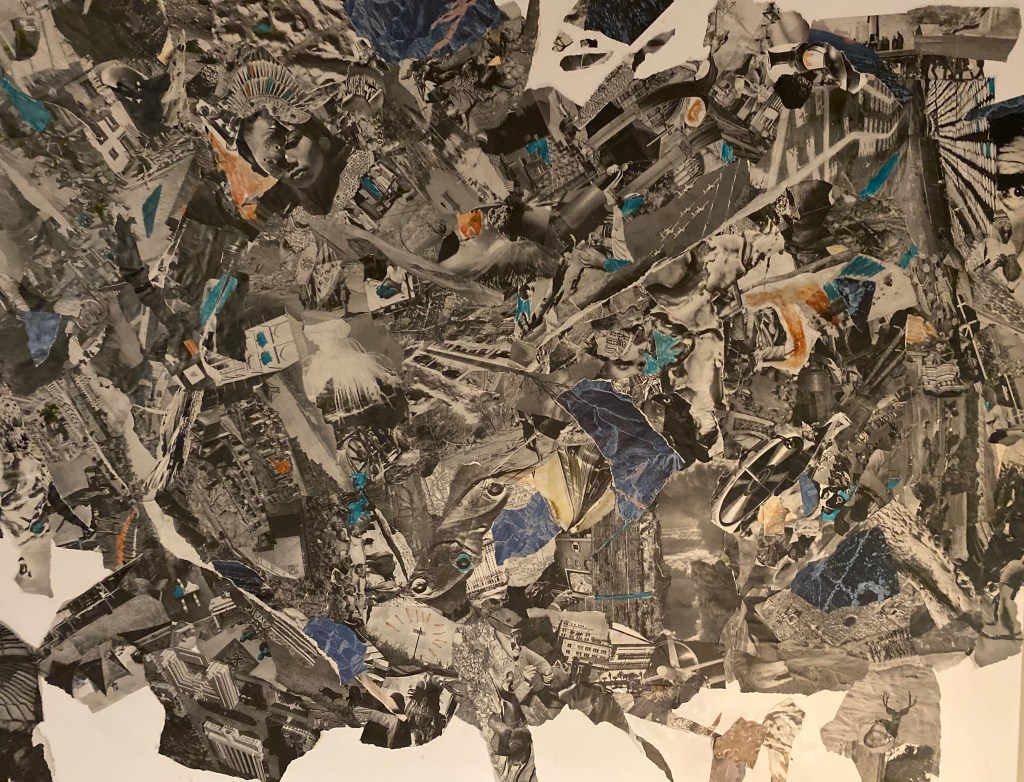
“Moon Maiden” was created quickly, guided by the subconscious. The artwork captures a fragmented, almost lunar-like landscape with black-and-white tones and splashes of teal and orange that lend tension to the piece. The Goddess herself, adorned with a detailed, textural headdress, holds a hauntingly stoic expression. Her face merges the human and the otherworldly, as soft portraiture contrasts with sharp, geometric shapes, creating a sense of dissonance and reverence. The piece suggests a story or myth emerging from these layers, as if she is a deity reclaiming identity amid chaos. Leaving parts of the canvas open was a first for me, allowing archipelagos of space debris to form around the central figure.
This openness not only reflects the Moon’s vast surface but also gives a feeling of isolation, as if fragments of her story orbit something unseen. The decision was spontaneous yet intentional—once I named the piece Moon Maiden, I knew I wanted these spaces to stay unfilled, adding to the mystery and inviting viewers to interpret what might lie beyond. This approach—combining open space with subconscious imagery—has started influencing my other pieces. “Prometheus Trashed,” “One Small Step for a Turtle,” and “Sticky Yggdrasil” also share this theme of openness and fragmentation. It all started with “Queen of the Last Wild Frontier.” Each work carries a message about technology and caution, showing the resilience in what’s left amidst the chaos. In my mythology, the gaps represent not only the myths themselves but also serve as a warning against our overreliance on technological progress, creating space for reflection on what we may be losing.
Andromeda Triumphant
Mixed Media 48×36″
2022
$5000
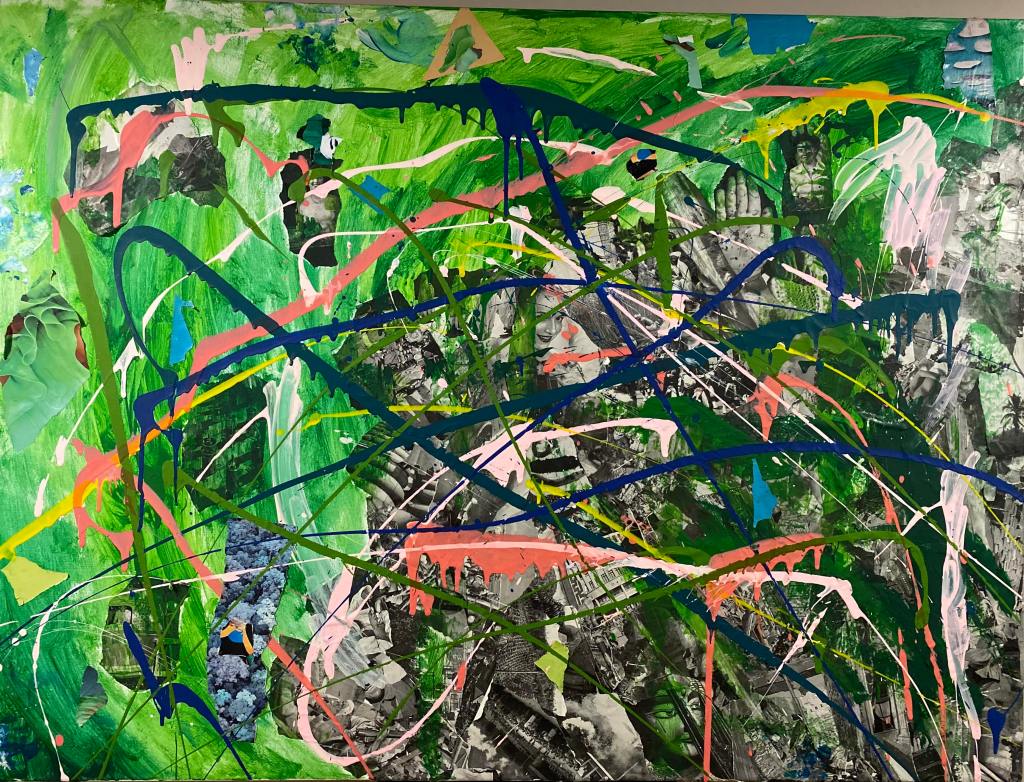
“Andromeda Triumphant” emerged as my vision of the Andromeda myth with a modern twist, weaving her tale of survival and transformation into my ongoing theme of technology’s uneasy clash with nature. Andromeda’s story—a young woman offered as a sacrifice to the monstrous consequences of human actions—felt fitting to explore in a world where humanity often attempts to overpower nature.
In the painting, the vivid green serves as a symbol of nature’s resilience, creating a lush and unruly backdrop, a reminder that nature is both the setting and force behind Andromeda’s triumph. The splashes of blue, pink, yellow, and peach represent her tenacity and freedom, an uncontainable energy pushing through, like something organic fighting against containment.
As I layered collage fragments of hands and faces into the swirling green, they became symbols of humanity’s influence—both its ingenuity and arrogance. These black-and-white, fragmented figures feel almost ghostly, as if watching the scene from a distance or from another time. They suggest those who once chose Andromeda’s fate, their faded presence a testament to the potential consequences of humanity’s reckless attempts to tame the wild. For me, these faces and hands aren’t only witnesses to Andromeda’s victory but silent reminders of the technology-driven world that can seem blind to nature’s force, or, worse, at odds with it.
The painting’s chaotic energy, from the unruly splatters to the controlled placement of collage, reflects a world where humanity and nature stand in tension. Andromeda Triumphant is a vision of a victory that isn’t just personal but symbolic—a reminder that nature, like Andromeda, can endure and even thrive despite what’s inflicted upon it. The work captures a complex triumph, one marked by scars from the battle between technology and the organic world, and it challenges us to look closer, to consider our role in this ongoing struggle and the cost of attempting to conquer what is beyond us.
What Is Sin?
Mixed media 48×36″
$5000
2019
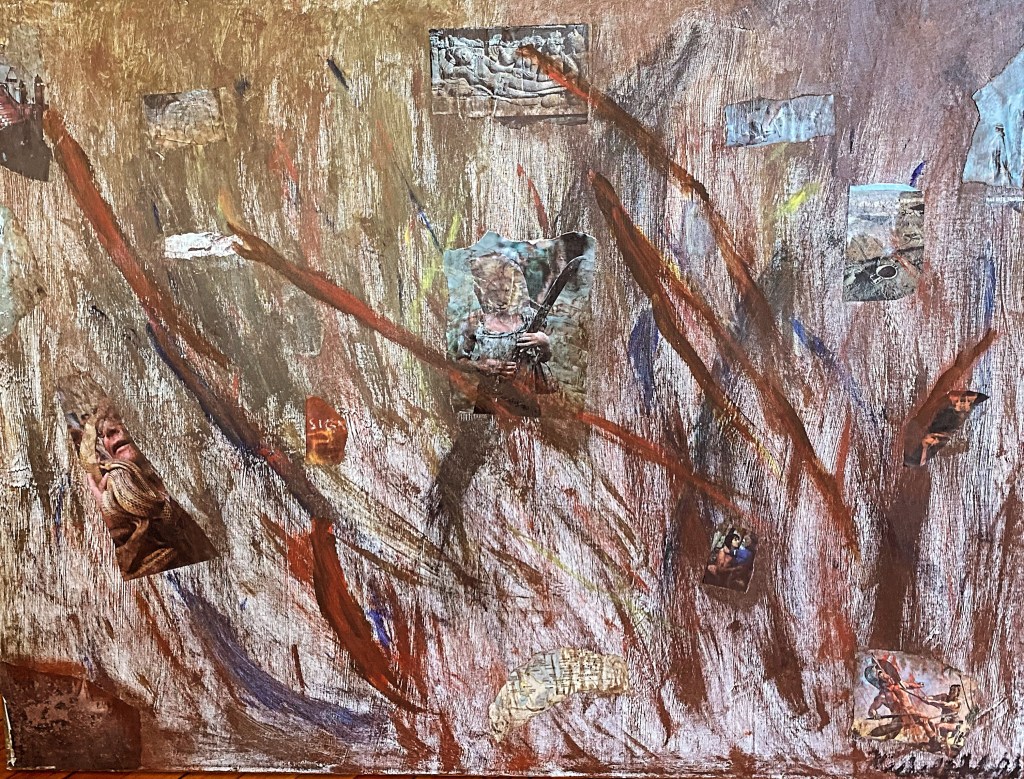
What Is Sin? examines the construction of moral categories from an atheist perspective. The work does not attempt to answer the question theologically. It interrogates who defines sin and how those definitions shift across cultures and time.
At the center of the composition is Sekhmet, a deity associated with destruction, protection, and divine wrath. Her presence destabilizes fixed moral categories. If destruction can be sacred in one system and condemned in another, morality is revealed as conditional rather than absolute.
Fragments referencing gluttony, lust, wrath, war, the devil, and other gods appear throughout the composition. These categories have been labeled sinful within certain religious frameworks, yet history shows they are culturally dependent. The inclusion of Aztec warriors fighting reinforces this instability. Warfare ritualized as sacred in one civilization becomes framed as barbaric through another moral lens. Sin shifts depending on who holds power.
A recurring element in the work is the embedded map. The map appears in many of my early New Mythology pieces and functions as a grounding device. It references geography, borders, and the way belief systems attach themselves to land and culture. Moral codes, like political boundaries, are drawn and enforced. The map acts as a calling card — a reminder that belief and morality are mapped onto territory rather than universally fixed.
The surface of the painting is tangled and striated, like roots exposed beneath the earth. The imagery feels embedded rather than floating. Sin is presented as something grown deep into the roots of history — intertwined with culture, conquest, survival, and power. It is inherited before it is questioned.
What Is Sin? positions morality as human architecture. It asks whether transgression is cosmic decree or social construction, and whether the lines between sacred and sinful are drawn by divine will or by those who control the narrative.
Hipster Jesus and Hoodie Mary, Demon Hunters! Tonight only! Live on the WBC!
Mixed Media
30×24”
2018
$10,000
This work functions as the flagship of my New Mythology series.
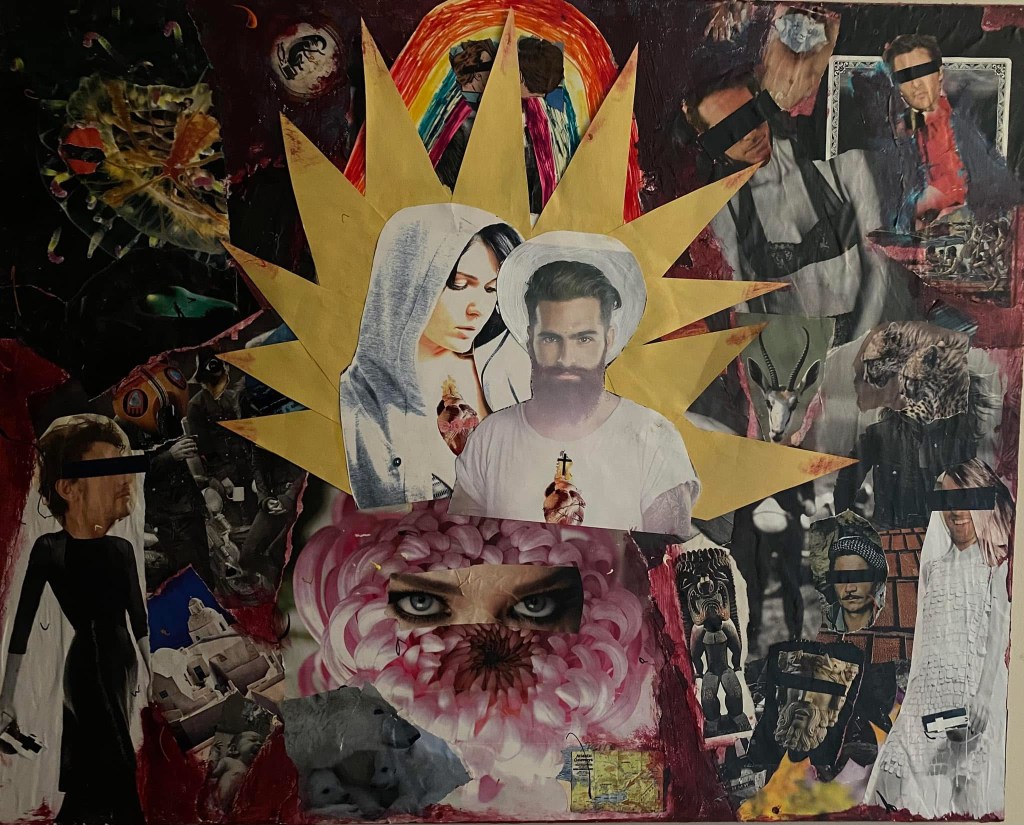
Hipster Jesus and Hoodie Mary, Demon Hunters! Tonight only! Live on the WBC! reframes religious iconography as spectacle. The central figures are deliberately contemporary — Jesus in a t-shirt, modern haircut, visible tattoos; Mary in a hoodie. They are styled not as distant relics but as media-ready personalities. Holiness is rebranded.
Both figures bear anatomical sacred hearts on their chests. Hipster Jesus wears a halo made of white paper — a constructed emblem rather than radiant aura. Mary glows. The contrast underscores the tension between manufactured sanctity and inherited visual language.
Behind them, a large yellow starburst radiates outward and a crayon rainbow arcs across the composition. These two elements physically project off the surface like a pop-up book, emphasizing theatricality. Faith becomes staged spectacle.
Beneath the rainbow, two cartoon men with black bars across their eyes kiss. The gesture directly confronts rhetoric that frames queer identities as moral threats. The black bars signal censorship, suppression, and the policing of identity. The satire is explicit.
At the bottom far right stands a figure with a man’s head on a woman’s body wearing a wedding dress, holding a cross. At the bottom far left stands another figure with a man’s head on a woman’s body in a black dress, also holding a cross. Additional figures throughout repeat this hybrid structure — men’s heads placed on women’s bodies — directly referencing how trans bodies are distorted, misrepresented, and weaponized within religious extremist narratives. The crosses they hold underscore the tension between doctrine and lived identity.
Anthropomorphic flowers and animals appear throughout the piece, heightening the absurdity and reinforcing the constructed, almost cartoon-like intensity of the spectacle.
The reference to WBC points to the spectacle of religious extremism and its reliance on visibility and outrage. It also echoes the language of televised wrestling and pay-per-view events, reinforcing the idea of moral crusade as staged entertainment. Righteousness becomes programming. Salvation becomes a show.
The yellow starburst is smeared with the artist’s own blood. The glow is stained. Sanctity is not clean. The mythology is not abstract. It is embodied.
Within the New Mythology series, this work constructs a contemporary archetype: religion as branding, righteousness as performance, moral panic as entertainment.
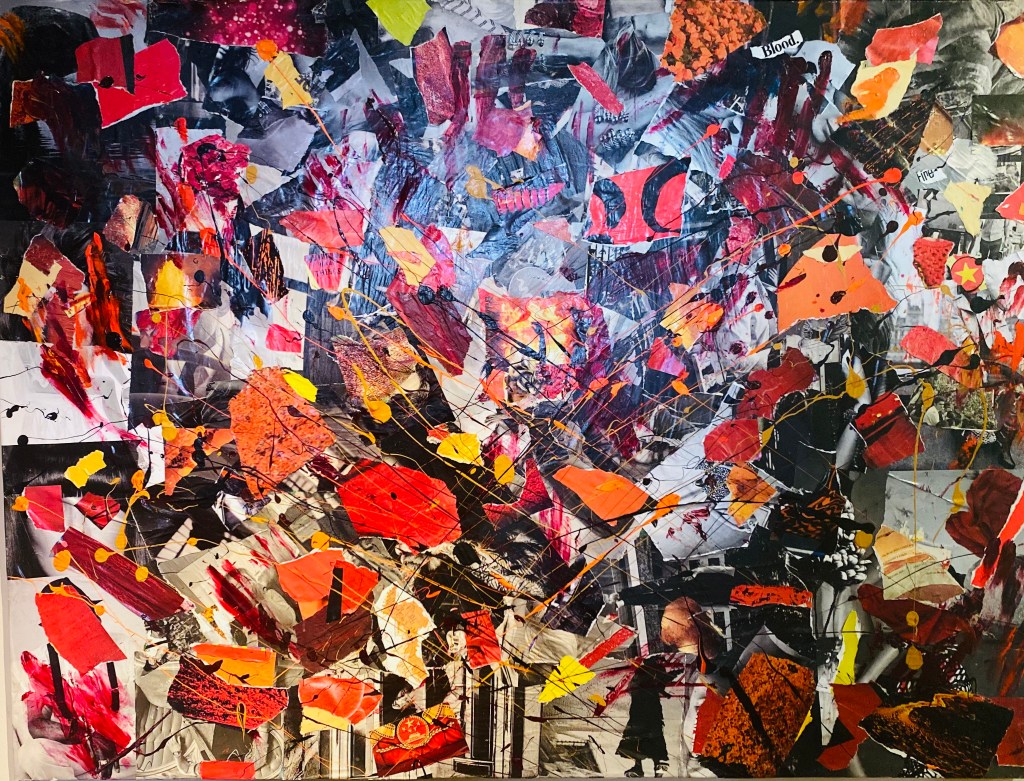
Blood and Fire
Mixed media 48×36″
2018
$5000
Blood and Fire constructs a landscape shaped by elemental forces rather than narrative. The composition is fractured and in motion. Red fragments move across the surface like suspended magma, each one a floating stone of heat and pressure. The piece reads as geological formation rather than theatrical flame — matter in the process of becoming.
Real blood is mixed directly into the red paint. It is materially present in the surface. Blood represents lineage, consequence, and the human cost embedded within systems of authority. The work does not simulate sacrifice. It incorporates it.
Portions of the surface were scorched with actual fire. Burn marks remain visible. Destruction is not depicted from a distance. It altered the object itself.
From the field of flame, a hand emerges. The gesture reads as rebirth — life rising through rupture. Near this hand appears a tiger eye. The eye introduces primal awareness into the moment of emergence. Instinct and rebirth occur together. Renewal here is not gentle. It is animal, alert, and ancient.
Royal imagery and architectural structures appear near the base of the composition, referencing hierarchy and inherited power. Positioned within blood, burn, and magma-like fragments, these symbols suggest that authority is forged under pressure rather than granted by divine right.
At the bottom of the piece stands a shadow girl. She anchors the composition at its foundation. She exists at the convergence of heat, lineage, and structure. She is elemental presence within a system still forming.
Blood and Fire presents myth as process rather than story. Power, identity, and authority are shown as forces shaped by pressure, combustion, survival, and emergence.
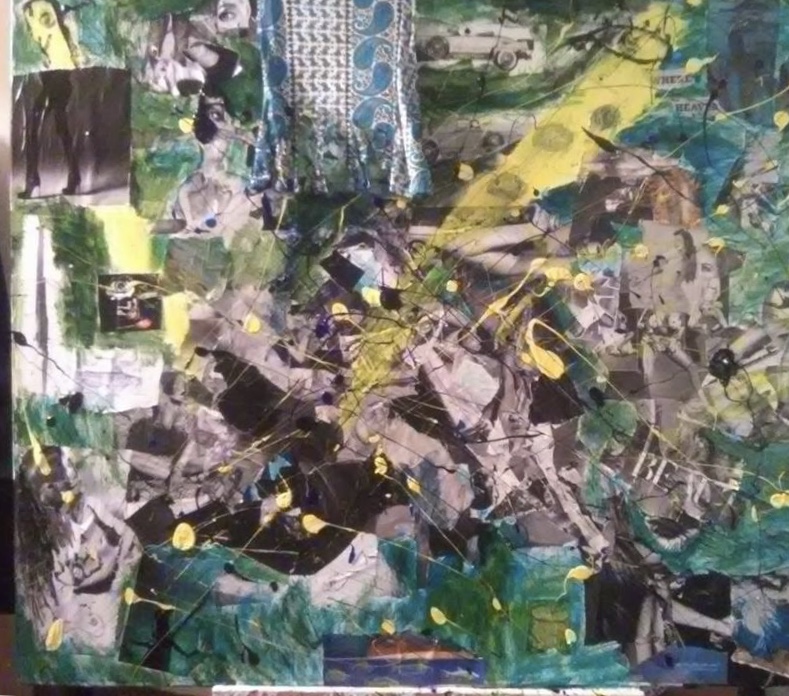
Refugee
Mixed Media 48×36″
2017
$5000
In this piece I use the language of myth to talk about something contemporary and painfully human. The ocean is not background. It is force. It is history. It is migration. It is indifference.
Fragments of black-and-white figures surface like memories or wreckage. Cyclops appear throughout the composition. The single eye repeats as a symbol of partial vision. We see, but we do not fully see. We witness, but selectively. Mythic scale replaces human scale.
The horse, symbolic of Poseidon, emerges within the chaos. Poseidon represents the sea in its full power: beautiful, violent, unpredictable. The horse here is not triumphant. It is submerged within the same current that carries everything else. Power and vulnerability occupy the same water.
The most important figure in the work is not immediately visible. A blue refugee child is concealed behind fabric I refer to as the lunatic fringe. This is not painted illusion. It is textile. The viewer must physically draw the fringe aside to reveal the child. The painting is interactive by design.
If the viewer does not move the fringe, the child remains unseen.
This gesture mirrors the way displacement is often treated in contemporary culture. We are surrounded by spectacle, myth, politics, and noise, while the individual human life remains hidden just beyond the edge of attention.
The work asks a quiet question: will you choose to look?
In the New Mythology Series, I use ancient symbols to confront modern crises. The gods remain loud. The sea remains powerful. But the refugee is still behind the fringe.
Queen of the Last Wild Frontier
Mixed media 30×24″
2015
SOLD
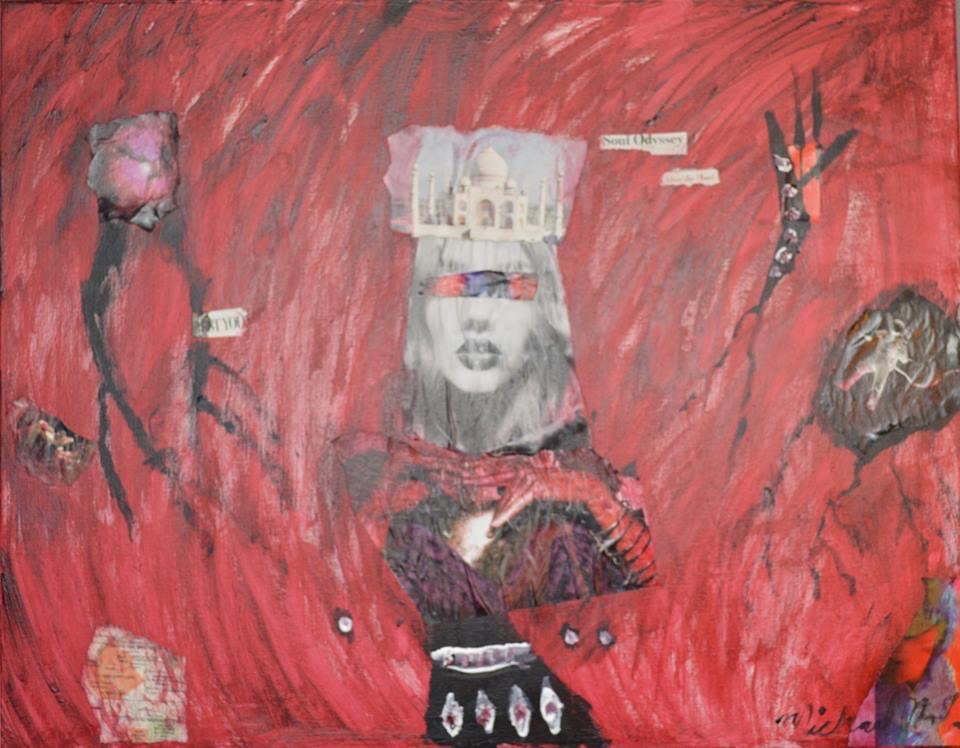
Queen of the Last Wild Frontier positions space as the final untamed territory — the last wild frontier beyond land, nation, and gravity. The red field is cosmic atmosphere, radiation, stellar burn. It is also amniotic. It operates simultaneously as outer space and womb. The frontier is expansion, but it is also origin.
Beneath the nebula, the words Just You appear. In the immensity of space, identity is stripped to singularity. No nation. No institution. No imposed narrative. Just you. The phrase anchors the work in personal sovereignty inside cosmic scale.
At the center stands the Queen, immense in presence. She wears the Taj Mahal as a crown, taken from Earth as plunder. A monument built to embody devotion, permanence, and empire now rests as regalia. It is not diminished. She is magnified. She is vast enough to wear civilization itself.
Next to her, the words Soul Odyssey reinforce the journey. This is not simply space travel. It is interior migration. The odyssey is spiritual, bodily, existential. It is about leaving imposed structures and claiming authorship over one’s own narrative.
A censor bar crosses her eyes, yet they burn through it. The gesture speaks to suppression, imposed silence, and control over women’s bodies and visibility. The gaze refuses containment. Authority radiates despite obstruction.
Her hand rests over her heart in command. Around her, disembodied arms extend into the red expanse — gestures of reach, authorship, and expansion. They suggest autonomy moving outward into frontier.
To the right, an astronaut floats inside an amniotic sac. The tether reads as an umbilicus. Exploration becomes gestation. The human figure is not conquering the frontier but forming within it. The astronaut is small beside her magnitude. Traditional myths of heroic conquest dissolve into an image of birth.
Embedded within the composition is a random map, a recurring element in my work. The map represents inherited systems of navigation, ownership, and division. Placed inside a cosmic womb, those constructed borders become provisional and fragile.
Within this red atmosphere, the work becomes a statement on bodily autonomy. In a post–Roe v. Wade landscape, the frontier is not geographic. It is the body. It is sovereignty over reproduction, vision, and identity. The Queen does not wait for permission. She defines the conditions of emergence.
This work is part of my New Mythology series, where contemporary artifacts and cultural symbols are reassembled into new archetypes. In this piece, space is the last wild frontier. The Queen governs it.
And within it her heir is being born. And within it, the journey is singular. Just you. A soul odyssey into self-determination.
A META NEW BEGINNING
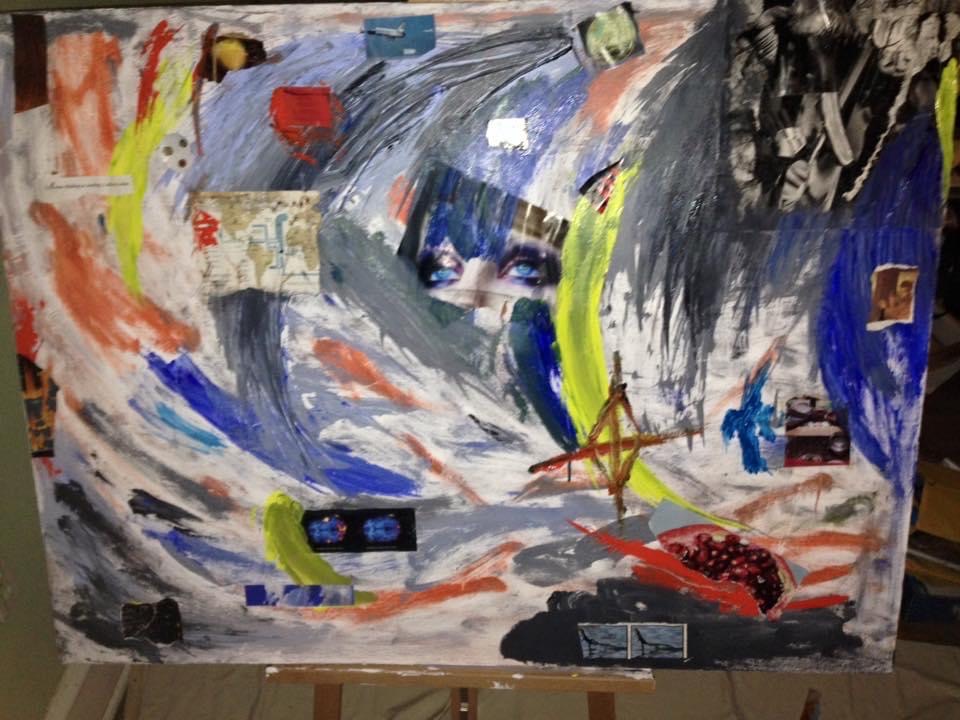
Miles To Go
Mixed media 48×36″
2015
SOLD
Miles To Go is a meta work. The subject of the piece is the process of creating the piece itself. It is not about mythology or archetype. It is about the act of returning.
This was my first painting after twenty years away from painting. The work documents the re-entry. It captures the friction, acceleration, doubt, momentum, and stamina required to begin again.
The piece was commissioned, and I was given complete artistic control. That freedom shaped the direction of the work. There were no thematic restrictions, no imposed narrative. The only subject left was the act of making. After twenty years, the act itself was the frontier.
The painting was created during an all-night session fueled by prodigious amounts of coffee. A map referencing coffee and the neurological effects of caffeine is embedded in the composition. It is literal. Caffeine influenced the pace, the brushwork, and the mental state behind the marks. The painting records that chemical acceleration.
The surface reflects that condition. Brushwork moves in competing directions. Colors interrupt one another. White space remains exposed. Nothing fully resolves. The composition resists a stable focal point because the mind in that moment resisted stillness. The piece functions like neural activity under stimulation, fragments surfacing and colliding.
In the red square are the complete lyrics to In My Life by The Beatles. The song centers on memory and reflection. While the body pushed forward into new work, the mind looped backward through history. The red square becomes an emotional anchor within the turbulence.
The fragment of eyes embedded in the composition acts as both observer and participant. It suggests awareness inside the act of creation. The painting watches itself being made.
Miles To Go refers to endurance. It references the distance between absence and return, between exhaustion and completion, between hesitation and momentum. It acknowledges that beginning again does not erase the years away. It carries them.
This work does not construct a mythology. It marks the moment the engine started again.

